4 min read· 8 reads
Artificial Intelligence Is Entering a New Era: It's No Longer Just About Better Models, But Smarter Infrastructure
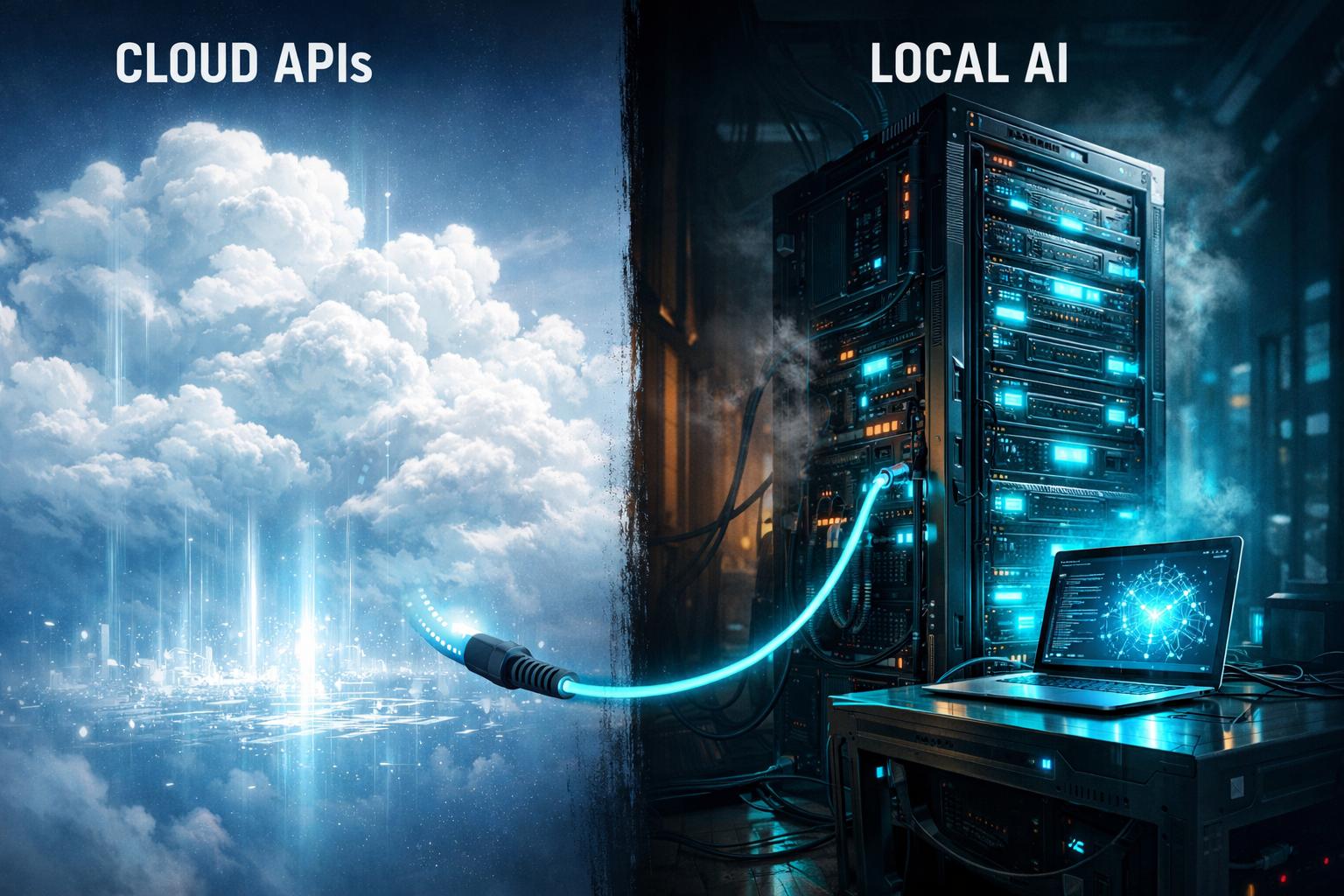
The Shift from Cloud AI to Edge AI
For the past few years, artificial intelligence has been dominated by cloud-based large language models (LLMs). Platforms such as ChatGPT, Claude, and Gemini have transformed how individuals and businesses interact with AI.
However, as adoption has accelerated, several challenges have become increasingly apparent:
- Rising cloud infrastructure costs
- Recurring subscription fees
- Dependence on a constant internet connection
- Growing concerns about data privacy
- Enterprise security and compliance requirements
By 2026, the industry is clearly moving toward a new direction.
Competition is no longer focused solely on building the most capable AI model. Increasingly, it is about delivering the most efficient, secure, and flexible AI infrastructure.
Two major trends are leading this transformation:
- Edge AI
- Multi-Model AI Platforms
Together, these technologies are expected to redefine how artificial intelligence is used across both businesses and personal computing.
What Is Edge AI?
Edge AI refers to running artificial intelligence directly on a user's device rather than processing requests in remote cloud servers.
Traditional workflow:
Computer → Internet → Cloud Server → AI Model → Result
Edge AI workflow:
Computer → AI Model → Result
This approach offers several significant advantages:
- Reduced dependence on internet connectivity
- Faster response times
- Lower operational costs
- Enhanced privacy by keeping sensitive data on the local device
For industries handling confidential information—including healthcare, legal services, finance, government, and research—Edge AI represents a major advancement in secure AI deployment.
Creative Fabrica Studio Desktop: A Practical Example of Edge AI
One of the latest examples of this trend is Creative Fabrica Studio Desktop.
Available for both Windows and macOS, the application allows users to perform AI-powered creative tasks directly on their computers, including:
- Background removal
- AI image upscaling
- Image generation
- Text-to-speech conversion
According to Creative Fabrica, these capabilities can run locally without requiring users to upload prompts or files to external servers. Users also have the option to switch to cloud-based models whenever additional computing power is needed.
For organizations subject to regulations such as GDPR and other data protection frameworks, local AI processing significantly reduces privacy risks while improving operational security.
The Era of Using Just One AI Model Is Ending
Today's professionals rarely rely on a single AI assistant.
Instead, they often switch between:
- ChatGPT
- Claude
- Gemini
- Perplexity
- Mistral
- DeepSeek
Each platform has unique strengths, but constantly moving between different interfaces creates a measurable productivity cost.
This "context-switching" has become one of the biggest inefficiencies in modern AI workflows.
Multi-Model AI Platforms Are Becoming the New Standard
To solve this challenge, a growing number of AI platforms now aggregate multiple models within a single interface.
Instead of maintaining several subscriptions and switching between browser tabs, users can:
- Submit the same prompt to multiple AI models simultaneously
- Compare responses side by side
- Access dozens of AI tools through one subscription
- Manage their entire workflow from one dashboard
This approach is particularly valuable for:
- Software developers
- Content creators
- Legal professionals
- Marketing teams
- Researchers
- Business consultants
The result is higher productivity, better decision-making, and improved workflow efficiency.
Google Is Unifying Its AI Ecosystem
Major technology companies are also shifting their strategy.
Rather than offering standalone AI products, they are integrating services into comprehensive ecosystems.
Google's transition from NotebookLM to Gemini Notebook reflects this broader strategy.
The new branding brings Notebook closer to the Gemini ecosystem while preserving existing notebooks, user permissions, and privacy protections. According to Google, the rebranding does not introduce retroactive changes to user data handling or existing service terms.
This move demonstrates that future AI platforms will be built around unified experiences rather than isolated applications.
The Three Factors That Will Define the Future of AI
Over the next several years, AI platforms are likely to compete on three critical dimensions.
1. Data Privacy
Can users trust that their data remains under their control?
2. Infrastructure Efficiency
Is AI processed in the cloud, on the edge, or through a hybrid architecture?
3. Model Diversity
Can users choose the most suitable AI model for each task instead of relying on a single provider?
Conclusion
Artificial intelligence is entering a new phase where infrastructure matters just as much as intelligence itself.
Edge AI is making AI faster, more private, and more cost-efficient by moving computation closer to users.
Meanwhile, multi-model AI platforms are simplifying complex workflows by allowing professionals to access multiple AI systems through a single interface.
At the same time, major technology companies are consolidating their ecosystems to deliver more integrated AI experiences.
For businesses embracing digital transformation, the most important question is no longer:
"Which AI model is the smartest?"
Instead, the real question has become:
"Which AI infrastructure enables smarter, safer, and more efficient work?"
Organizations that answer this question successfully will be better positioned to lead the next generation of AI-driven innovation.